
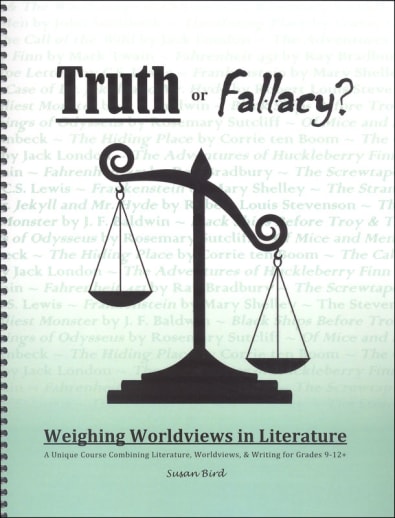
All literature focuses on themes rooted in a Biblical foundation: good vs evil, power, conflict, loss, and more. But, is the novel you're reading mirroring Biblical truth or fallacy? Subtitled, Weighing Worldviews in Literature, this text provides teachers the tools to teach students how to identify and evaluate text material. For each novel, students evaluate literary value and worldview distinctives through essays, activities, and discussion. The text includes a suggested 1-year syllabus and 20 pages of teacher materials (including reproducible forms, literary helps, writing tips, and more). Course recommends meeting in a small group setting approximately 2 hours weekly for 32 weeks – perfect for siblings or co-op.
Students engage with each of 11 novels. These alternate between Biblical and secular world views (Frankenstein; The Strange Case of Dr. Jekyll and Mr. Hyde; The Deadliest Monster; Black Ships Before Troy; The Wonderings of Odysseus; Of Mice and Men; The Hiding Place; The Call of the Wild; The Adventures of Huckleberry Finn; Fahrenheit 451; and The Screwtape Letters). Depending on your edition choices, this equates to just over 1800 pages of reading—a fairly average amount of reading. Also required are 3 TrueU Worldview DVDs (Does God Exist; Is the Bible Reliable? or Who is Jesus?). Students watch these episodes weekly, discussing, and applying concepts to each book.
Follow a 3-week pattern for each novel. In Week A, students begin reading the assigned novel and watch assigned worldview episodes. Prior to Week B, students are to finish the reading and have filled out the included Book Evaluation Form, focusing on literary content, style, and worldview. Teachers guide discussion and analysis (suggested, but not scripted answers provided). Various provided activities (a little prep needed) reinforce learning: students might match characters to their words; read dramatically; complete a worldview crossword; and more. They'll analyze and discuss each text's literary elements, world view, ideas, writing style, and morality. During Week C, students identify and respond in essay format to Truth (defined by God's Word) vs Fallacy found in the literature and present their analysis. Key elements of a 5-paragraph essay are overviewed, but the text assumes students have a working understanding and experience with composing skills. Essays require students to identify and respond to the writing's truths and fallacies, presenting these thoughts to the class (or family). Early units provide thesis statement suggestions, but later units expect independent work. Each unit provides sample student essays from a variety of grades—worthwhile for teaching, discussion, and analysis. Students will create a binder of their work.
The publisher suggests assigning 1.5 credits of literature and composition (2 credits if spending 90 minutes daily 4x per week) with the possibility of a ½ credit in Bible/worldview. Spiral bound, 188 pgs, pb. ~ Ruth