These icons are designed to help you quickly understand and learn important information about our products.
Teaching Method
Traditional
Teacher-centered curriculum commonly used in classrooms that may include a text, teacher manual, tests, etc.
Charlotte Mason
A methodology based on the work of a 19th century educator who maintained that children learn best from literature (Living Books), not textbooks.
Classical
A methodology based on the Latin Trivium (three stages of learning), including the grammar stage (memorization and facts), logic stage (critical thinking), and rhetoric stage (developing/defending ideas).
Unit Study
A thematic or topical approach centered around one topic that integrates multiple subject areas.
Montessori (Discovery)
A methodology based on the work of a 20th century educator that emphasizes student and sensory-driven discovery learning and real-life applications.
Other
Other methodologies
Religious Content
Secular
Contains content contrary to common Christian beliefs (i.e. evolution).
Neutral
Avoids religious or theoretical topics or presents multiple viewpoints without preference.
Christian/Religious
Faith-based or including instructional religious content.
Learning Modality
Auditory
Learns through listening, talking out loud or reading out loud.
Visual
Learns through seeing, prefers written instructions and visual materials.
Kinesthetic/Tactile (Hands-On)
Learns through moving, doing and touching.
Multi-Sensory
Curriculum that employ a variety of activities/components.
Presentation
Sequential
Curriculum progresses through well-defined learning objectives. Emphasizes mastery before moving to the next topic.
Spiral
Topics and concepts are repeated from level to level, adding more depth at each pass and connecting with review.
Conceptual/Topical
Focus is on the “why,” often with a unifying concept as well as specific skills; coverage may be broader.
Teacher Involvement
Low Teacher Involvement
Student-led materials; parent acts as a facilitator.
Medium Teacher Involvement
A mix of teacher-led time and independent student work.
High Teacher Involvement
Teacher-led lessons; may utilize discussions, hands-on activities and working together.
Additional Materials Required
No other materials needed
Everything you need is included.
Other Materials Required
There are additional required resources that are a separate purchase.
Other Materials Optional
There are additional resources mentioned or recommended but are not absolutely necessary.
Publisher's Description of Green n Learn Sensory Pattern Blocks
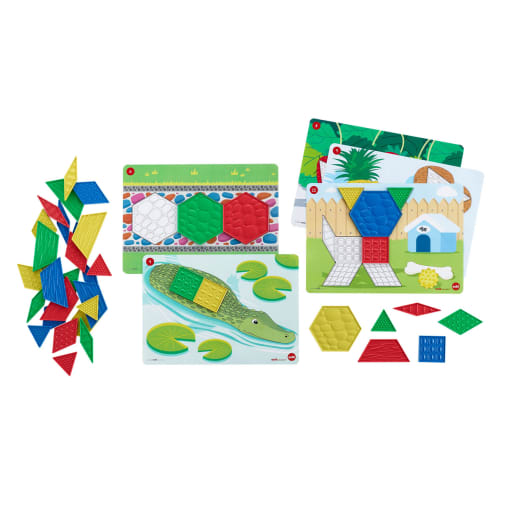
Pattern blocks are a must-have in every early years setting—whether that’s a nursery, preschool, or home learning environment. With their vibrant colors and simple geometric shapes, they offer endless possibilities to explore early math, language development, fine motor skills, and creative thinking.
One of our newest favorites is the Green-n-Learn Sensory Tangram Set, made from sustainable materials and designed to support tactile exploration. These textured pattern blocks are ideal for sensory play and are perfect for building key skills in a fun, eco-friendly way.
Here are 10 exciting and educational ways to use pattern blocks at home or in the classroom with young children.
Shape Scavenger Hunt - Turn learning into a game! Hide pattern blocks around your home or classroom and encourage children to find and name them. Ask questions like “How many sides does this shape have?” or “Can you find a red triangle?” A great way to promote shape recognition, problem-solving, and gross motor development.
Sensory Tray Exploration - Add the Green-n-Learn Sensory Pattern Blocks to a sensory tray filled with sand, rice, or lentils. Children can dig, discover, and sort shapes while engaging their senses. Sensory trays are excellent for developing fine motor skills, tactile awareness, and early math vocabulary.
Build and Create - Ask children to use pattern blocks to create pictures—animals, rockets, houses, flowers—the only limit is their imagination! This open-ended activity builds spatial reasoning, and geometry skills, and encourages creative expression.
Pattern Making - Encourage children to copy, extend, or invent their own repeating patterns using different shapes and colors. This introduces them to key math concepts such as sequencing, logic, and early coding skills, all through playful interaction.
Storytelling with Shapes - Support language development and communication skills by inviting children to make up stories using their pattern block designs. For example: “Once upon a time, the green square met the blue triangle in the forest…” A wonderful way to encourage imaginative thinking.
Sort and Classify - Offer bowls or trays to sort shapes by color, size, or type. Sorting activities support cognitive development, logical thinking, and introduce children to the foundations of data handling and mathematical categorization.
Symmetry and Reflection Play - Use a small mirror to explore symmetry. Ask children to create one side of a design and watch the mirror complete it. This visual play introduces concepts of balance, reflection, and symmetry—important elements of early geometry.
Math Through Play - Use pattern blocks to count sides, group by numbers, or explore addition and subtraction. Roll a dice and collect that many shapes, or build number towers. These playful approaches help build numeracy, counting, and number sense.
Tactile Guessing Game - With their eyes closed, have children feel a shape and guess what it is—then find its match. Our Green-n-Learn Sensory Tangram Set makes this especially fun, supporting sensory integration, memory, and descriptive language skills.
Collaborative Design Time - Encourage teamwork by building a large group mosaic using pattern blocks. This promotes social development, cooperation, and helps children practice important social-emotional skills like sharing, turn-taking, and collaborative decision-making.