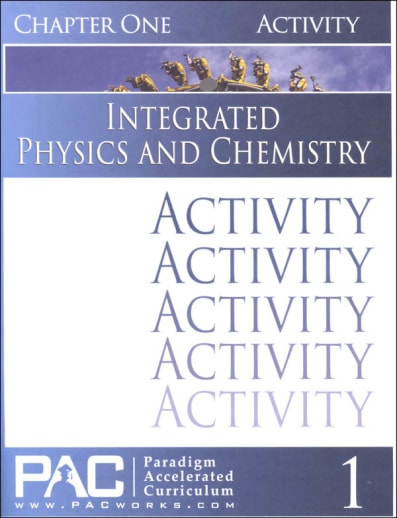
Integrated Physics and Chemistry Chapter 1 Activities

SKU
003573
ISBN
9781594761737
Grade 8-12
Teaching Method
Traditional
Teacher-centered curriculum commonly used in classrooms that may include a text, teacher manual, tests, etc.
Charlotte Mason
A methodology based on the work of a 19th century educator who maintained that children learn best from literature (Living Books), not textbooks.
Classical
A methodology based on the Latin Trivium (three stages of learning), including the grammar stage (memorization and facts), logic stage (critical thinking), and rhetoric stage (developing/defending ideas).
Unit Study
A thematic or topical approach centered around one topic that integrates multiple subject areas.
Montessori (Discovery)
A methodology based on the work of a 20th century educator that emphasizes student and sensory-driven discovery learning and real-life applications.
Other
Other methodologies
Religious Content
Secular
Contains content contrary to common Christian beliefs (i.e. evolution).
Neutral
Avoids religious or theoretical topics or presents multiple viewpoints without preference.
Christian/Religious
Faith-based or including instructional religious content.
Learning Modality
Auditory
Learns through listening, talking out loud or reading out loud.
Visual
Learns through seeing, prefers written instructions and visual materials.
Kinesthetic/Tactile (Hands-On)
Learns through moving, doing and touching.
Multi-Sensory
Curriculum that employ a variety of activities/components.
Presentation
Sequential
Curriculum progresses through well-defined learning objectives. Emphasizes mastery before moving to the next topic.
Spiral
Topics and concepts are repeated from level to level, adding more depth at each pass and connecting with review.
Conceptual/Topical
Focus is on the “why,” often with a unifying concept as well as specific skills; coverage may be broader.
Teacher Involvement
Low Teacher Involvement
Student-led materials; parent acts as a facilitator.
Medium Teacher Involvement
A mix of teacher-led time and independent student work.
High Teacher Involvement
Teacher-led lessons; may utilize discussions, hands-on activities and working together.
Additional Materials Required
No other materials needed
Everything you need is included.
Other Materials Required
There are additional required resources that are a separate purchase.
Other Materials Optional
There are additional resources mentioned or recommended but are not absolutely necessary.
Consumable
Consumable
Designed to be written in; not reusable.
Non-Consumable
Not designed to be written in; reusable.
Our Price
$6.80 $6.80 $6.65
Rainbow Savings: $0.15

Description

Publisher's Description of Integrated Physics and Chemistry Chapter 1 Activities

IPC consists of twelve chapters of text and twelve companion student activities. This course introduces students to the people, places and principles of physics and chemistry. It is written by internationally respected scientist/author, John Hudson Tiner, who applies the vignette approach which effectively draws readers into the text and holds attention. The author and editors have deliberately avoided complex mathematical equations in order to entice students into high school level science.

Focus is on research by the people who contributed to development of the Periodic Table of the Elements. Students learn to read and apply the Table while gaining insight into basic chemistry and physics. This is one of our most popular courses among high school students, especially those who aspire to matriculate to college, but are challenged by science courses based on complex mathematical and technical skills.

IPC is also an excellent science course for pre-high school students. The course is designed for two high school transcript credits. Teachers may require students to complete all twelve chapters for two transcript credits or may select only six chapters to be completed for one transcript credit for Conceptual Physics (cpts. 2, 4, 6, 9, 10, 12) or Basic Chemistry (cpts. 1, 3, 5, 7, 8, 11). Compliance with state and local academic essential elements should be considered when specific chapters are selected by teachers. As applicable to local policies, transcript credit may be assigned as follows when students complete all 12 chapters: Physical Science or Conceptual Physics for one credit, Chemistry for one credit, or Integrated Physics and Chemistry for two credits.

This high school science course introduces students to science and chemistry in an approachable, engaging way. Authored by John Hudson Tiner, the emphasis is on the people and principles that have made science into what it is today, not on memorizing and using formulas. The program is divided into 12 chapters, each packaged individually. While some chapters focus more exclusively on either chemistry or physics, many cover both. Throughout each chapter, plenty of anecdotes, biographies, and interesting details are shared, making it especially appealing to students who would otherwise probably not enjoy science as much. Designed as a two-credit course, six chapters of the course may also be studied for one credit (although local requirements may vary). Overall, a student will get a very thorough history and understanding of the science concepts in this course, but very little hands-on lab experience (the publisher cautions that additional lab classes may be needed for this program to count for the desired number of credits). However, this course may be a good option for the self-motivated student that does not have a solid math background, and is not looking to major in the sciences in college. - Jess

Details
More Information
Product Format:Softcover Book
Grades:8-12
Brand:Paradigm Accelerated Curriculum
ISBN:9781594761737
Length in Inches:11
Width in Inches:8.375
Height in Inches:0.125
Weight in Pounds:0.2
Videos
This product doesn't have a video
Reviews
Product Q&A