
Master's Class High School Physics Set
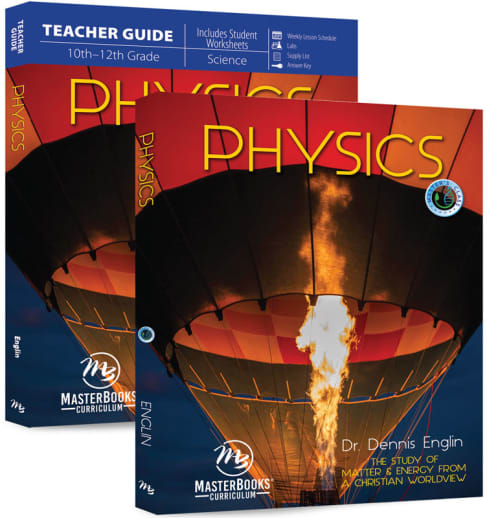
Description
Everything is made of matter which possesses energy, and with physics, we can study their interactions in everything around us. This course is designed to teach 10th – 12th grade students to learn and apply physics concepts to real life rather than simply memorizing them. Students will complete practice exercises and lab reports, take quizzes and exams, and conduct hands-on experiments as they see God’s hand in every aspect of their study. This course provides a sound foundation for those going on to college-level courses.
Physics is usually considered to be a secular study, but students will find that the precise predictability, exact quantitative nature, and intricate detail of the study of energy and matter are a constant testimony to God’s great wisdom and omnipotent and omnipresent control.
Course Objectives:
- Investigate the core concepts of physics, including scientific models
- Become familiar with the meanings of related scientific terms, such as velocity, acceleration, and kinetic and potential energy
- Use vectors as they demonstrate the direction and quantity of forces
- Learn about the conservation of matter and energy, and how matter and energy interact over time and space
- Conduct laboratory procedures and write reports with each week of study
- Identify God’s wisdom in the creation of the universe including the natural laws which form the basis for the study of physics
Course Details:
This is a one-year course with two full semesters, helping a student fulfill one credit of Physics with labs. The course work requires approximately 5 hours each week. High school transcripts should list the course as Physics with labs.
Pre-requisites: Algebra 1 and Chemistry
The Teacher Guide includes instructions for the course and labs as well as answer keys for worksheets, quizzes, lab reports, and exams.
This college preparatory, upper-level Physics course covers the basic concepts and applications of modern physics, while testifying to the omnipotent and omnipresent nature of God. Topically students study the core concepts of physics, including speed, velocity, acceleration, force, vectors, gravity, thermodynamics, light, refraction, reflection, electric circuits, radioactivity, time and space, and more. While it has been created for homeschool families, and provides easy to manage lessons, a schedule, and teaching support, this is a serious study of science with a typical high school lab experience. Students should plan to spend approximately 5 hours per week in the course. Prerequisites include Algebra 1 and Chemistry.
The softcover illustrated Textbook provides 28 chapters and glossary. Each chapter (or lesson) will take one week to complete. Chapters offer objectives, illustrations to help explain concepts, textual readings and step-by-step laboratory assignments. The text is well-written and clearly explains key concepts without the longer narrative of some courses. Each chapter includes a lab component and begins with a list of required materials, followed by the introduction, purpose, and step-by-step instructions. The lab procedures are well organized with a similar format: Observe, Questions, Research/Hypothesis, Experiment, Analyze and Conclusion. Students can complete the labs in a separate lab notebook or use the lab report form in the Teacher Guide. Students successfully completing the course should qualify to receive a high school transcript credit for a Physics with Lab course.
The Teacher Guide provides everything you need to guide students through the lessons. Course objects, description, instructions for using the course and the corresponding lab experience, daily schedule, worksheets and laboratory reports, quizzes and exams, and the answer keys to worksheets, lab reports, quizzes, and exams. The Daily Schedule is divided into semesters, with assignments 5 days per week. Chapter readings, review lessons, labs, quizzes, and tests are all scheduled for your planning convenience. Parents may modify the plans as needed to meet their individual student needs. Lab reports include a list of required materials, introduction, purpose, and procedure which is identical to what is found in the Text. This information is centered on the left side of the page, with the right side offering blank space for any lab notes. Following the conclusion are several questions ranging from fill-in-the-blank to short answer that help students analyze the experiments. Sample lab reports are included for the first two labs to provide parent grading guidance. Labs require a few household items and traditional lab equipment. Required supplies that are not readily available include: 100 g weight, 100 ml graduated cylinder, (2) 3.7 V Bulbs, 2 AA Battery holders, 2 bar magnets, biconvex lenses (50 mm fl and 150 mm fl), biconcave lens (150 mm fl), bulb holder, circuit switch, color paddles, diffraction grating, digital scale, electric motor assembly kit, galvanometer, insulated wire, iron fillings, metric ruler (3), meter stick, concave mirror (200 mm focal length), convex mirror (200 mm focal length), multimeter, red laser pointer, single beam penlight, single pulley (2), solar cell 1V-500mA, spectroscope, spring scale (3), thermometers (2) and Stargazers Guide to the Night Sky (item #053254). We expect a lab kit to be available from Cornerstone Educational Supply in early Summer. Also scheduled weekly are a worksheet and quiz related to the readings. Worksheets include a variety of fill-in-the-blank and short answer questions, while quizzes are multiple choice and matching. Tests (8 total) cover 3-4 lessons and are taken on Fridays, with the beginning of the week scheduled study time. At a glance, this may seem overwhelming, however, the Teacher Guide format and organization make it user-friendly for homeschooling parents to use successfully. Student pages are reproducible for your immediate family. Set includes a Teacher Guide and Textbook. ~Deanne
| Product Format: | Product Bundle |
|---|---|
| Grades: | 10-12 |
| Brand: | Rainbow Resource Center |