
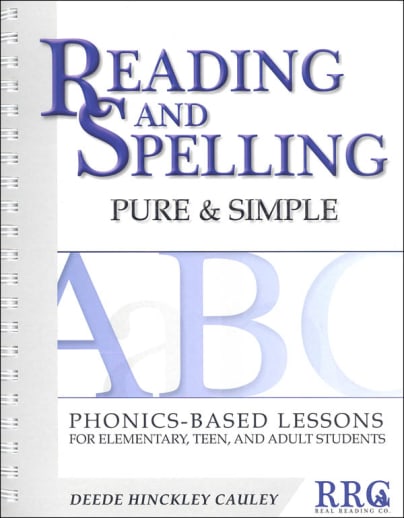
A series of 90 phonics lessons that systematically instructs through the skills needed for beginning, then emerging, then accomplished reading with an emphasis on sound patterns, comprehension, and spelling. A no-nonsense presentation without distracting graphics means these lessons will work as well with remedial and ELL/ESL students as they will with young students. This non-consumable manual provides ready-to-go lessons (detailed instructional sequences on left-hand pages with reading material for the student on the right-hand pages). Designed for one-on-one instruction, it can be used by itself or coupled with grade level workbooks for review and practice activities. Students can move at their own pace through four units; reading words from the first lesson. Unit 1 Short-Vowel Words; Unit 2 Long-Vowel Words and ||; Unit 3 More Vowel and Consonant Variations; and Unit 4 Putting it All Together. Includes a system for documenting student achievement. 275 pgs, spiral-bound.
Originally targeting students 3rd grade and up and used as an intervention program with ADD/ADHD, dyslexic, autistic and ELL/ESL students, this program is equally effective with young, beginning students. Lessons use a consistent four-step process: read, discuss word meanings, spell, and mark the chart. Each new concept and new pattern are introduced, learned, practiced, and reviewed. Additional support and information included as an appendix: ideas for the classroom, basic terms, index of letters/sounds, pronunciation guide, an index that shows when particular words are introduced, and reproducible completion charts and records.
There are consumable workbooks available separately. There are four exercises for each lesson: Read. Discuss, Spell (Ex 1); Rhyme These Words (Ex 2); Word Study (Ex 3); ABC Order (Ex 4); and Guide Words in the Dictionary (Ex 5). There is some overlap in lesson coverage between the workbooks with lessons covered at different grade levels having similar, but age-appropriate activities (font size and line size differs as well as number of examples).