
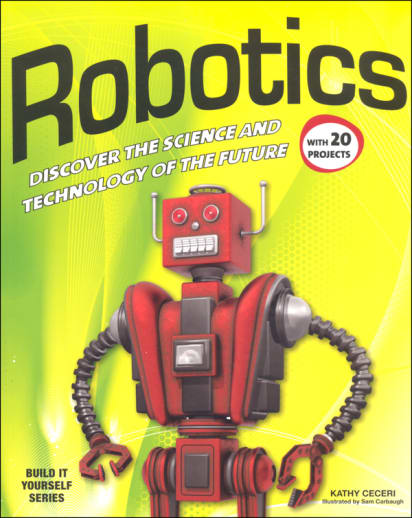
Robots are everywhere! Not just in toy stores or science fiction movies; did you know that robots are also in hospitals, factories, household appliances, and outer space? Through hands-on projects, Robotics teaches kids about the many functions of robots in science, technology, math, and everyday life. Each chapter focuses on a different topic, such as robot development, bodies, motion, and sensors. The text manages to be technical while remaining accessible and kid-friendly. Each chapter includes diagrams, fun facts, and bolded vocabulary words keyed to "Words to Know" glossary boxes. Twenty projects are included for kids to build their own robots, each containing an overview, list of supplies, and step-by-step instructions. While you'll likely have some of the more common items around the house, you'll probably need to make a trip to the hardware or hobby store for some (unless you already have DC motors or extra electrical wire lying around!) The book also suggests dollar stores as a resource for inexpensive motors and such, gained from cheap hand-held electric fans, keychain lights, and other items that can be taken apart for parts. You can even use salvaged parts from recycled toys and other household devices for some of the projects! Projects include: Art-Making Vibrobot, Hack a Line-Following Robot Car, Robotic Arm, Rolling Ball Tilt Sensor, and Binary Bead Jewelry. Several "pen and paper" Logo programming projects are included as well. The front of the book includes a robotics timeline; glossary, list of resources, and index are located in the back. Whether you complete all of the projects, or just a few, the information alone makes for a great read and is sure to spark curiosity in the STEM fields. ~ Lisa
Robotics
Description
Physics for the Logic Stage from Elemental Science takes middle school students into a deeper study of basic physics and its concepts including thermodynamics, mechanical waves, and electromagnet waves. Applications of physics concludes the year with a look at electricity, engineering and robotics, and nuclear physics. Rather than using a dry, uninspiring textbook, Physics for the Logic Stage uses visually appealing and engaging books, hands-on activities, and organized notebooking activities to provide the learning framework. Independent student learning is the goal, with parents guiding lessons rather than doing any direct teaching. The course is 36 weeks, with the option of either a 2 Day or 5 Day/week schedule laid out in the Teacher Guide. Physics for the Logic Stage Teacher Guide also includes the student assignments sheets, helpful tips to lead your student through the program, comprehension questions, unit tests, and answers for the student's work. The Physics for the Logic Stage Student Guide offers all the consumable student pages and assignments. Both Guides are required along with Spine Resources. Please note, the Usborne Illustrated Dictionary of Science is currently out of print. It may be available in the used marketplace or through the library system. Optional resources are included to enrich learning.
| Product Format: | Softcover Book |
|---|---|
| Grades: | 4-7 |
| Brand: | Nomad Press |
| ISBN: | 9781936749751 |
| Length in Inches: | 10 |
| Width in Inches: | 8 |
| Height in Inches: | 0.25 |
| Weight in Pounds: | 0.7 |