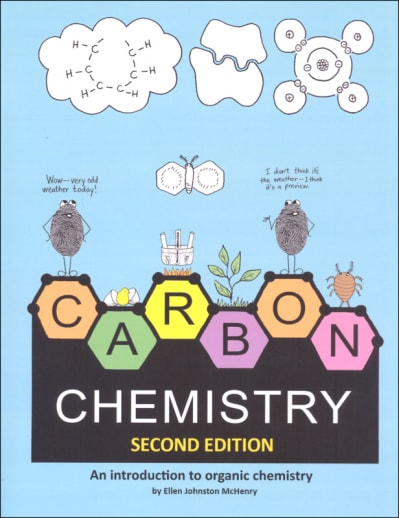
I think it takes a rare person to try to present basic chemistry at a level that an upper-elementary or middle-school student can understand, but ORGANIC chemistry? Normally, you only really scratch the surface of organic chemistry in high school, and if you go into a science-related field in college, then you're really hit with it. So, before I even cracked the cover, I was very impressed with Ellen McHenry's follow-up to her first chemistry program, The Elements. And parents, even if you never took organic chemistry, it's not as complicated as it sounds, and I'll bet you'll be drawn in as you learn along with the kids! It sounds advanced and frightening, but organic chemistry is really just an intersection of chemistry and biology, and learning how chemistry is vital to our every day life is fascinating. When you understand how molecules and substances act in your body, it can put a whole new aspect on the boring old chemistry you thought you knew!
Nine chapters cover a broad range of organic chemistry topics, including carbon; alkane hydrocarbons; "-enes" and "-ynes" (including alkenes, alkynes, benzene, etc.); functional groups and their combinations (carboxylic acids, adehydes, esters, and esters); plastics, rubber and silicones; carbon oxides, the carbon cycle and radioactive carbon. Sounds intimidating, I know, but her low-stress, straight-forward approach to these topics makes them understandable to just about anybody. The overall layout is similar to that of The Elements, with each chapter containing informational text interspersed with helpful diagrams and the ever-present, cute thumbprint guys, who have a comment for just about everything. At the end of each chapter you'll find comprehension questions, puzzles and/or reviews all designed to ensure understanding. Thankfully the answers to the above are found in the answer key. Student pages may be copied for your own use, which is great if you are planning on using the program with multiple children, and would also be a great tool for students making their own chemistry notebook. The course concludes with instructions for a Polymer Party, which reviews information from all the chapters. While some activities involve building molecules from different manipulatives, others are more "outside the box" and involve having a "burning contest" using different flammable objects, taking a virtual tour of a coal mine, making marbled paper (using alkanes!), dying eggs (to study the effects of acetic acid), sorting plastic using chemical analysis, and much more! I can't help thinking that college chemistry could have been so much more fun if we would have been able to do activities like this instead of drawing molecule after molecule! If you enjoyed The Elements, or have completed another basic chemistry program and would love to take your study of chemistry further, I definitely recommend continuing with this. If you would like to use this with children a bit older or younger than the recommended age range, the author has provided some advice on adjusting the material to fit those needs as well. On a final note, I want to add that even children that don't ordinarily enjoy chemistry, or found basic chemistry so-so, may be absolutely fascinated by organic chemistry. 164 pages, paperback. The CD which was formerly included with this course has been replaced by downloadable files on the publisher's website, which are referenced in select activities throughout the book. - Jess