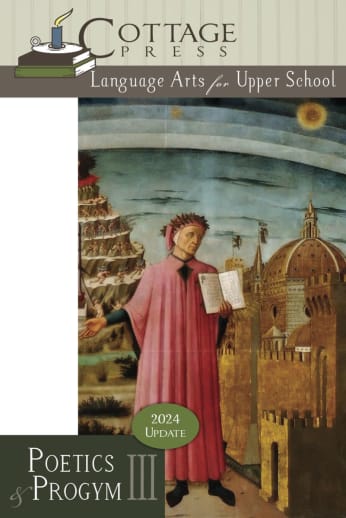
Language Arts for Upper School Poetics & Progym - Level III Student

SKU
018065
ISBN
9798333205773
Grade 8-12
Teaching Method
Traditional
Teacher-centered curriculum commonly used in classrooms that may include a text, teacher manual, tests, etc.
Charlotte Mason
A methodology based on the work of a 19th century educator who maintained that children learn best from literature (Living Books), not textbooks.
Classical
A methodology based on the Latin Trivium (three stages of learning), including the grammar stage (memorization and facts), logic stage (critical thinking), and rhetoric stage (developing/defending ideas).
Unit Study
A thematic or topical approach centered around one topic that integrates multiple subject areas.
Montessori (Discovery)
A methodology based on the work of a 20th century educator that emphasizes student and sensory-driven discovery learning and real-life applications.
Other
Other methodologies
Religious Content
Secular
Contains content contrary to common Christian beliefs (i.e. evolution).
Neutral
Avoids religious or theoretical topics or presents multiple viewpoints without preference.
Christian/Religious
Faith-based or including instructional religious content.
Learning Modality
Auditory
Learns through listening, talking out loud or reading out loud.
Visual
Learns through seeing, prefers written instructions and visual materials.
Kinesthetic/Tactile (Hands-On)
Learns through moving, doing and touching.
Multi-Sensory
Curriculum that employ a variety of activities/components.
Presentation
Sequential
Curriculum progresses through well-defined learning objectives. Emphasizes mastery before moving to the next topic.
Spiral
Topics and concepts are repeated from level to level, adding more depth at each pass and connecting with review.
Conceptual/Topical
Focus is on the “why,” often with a unifying concept as well as specific skills; coverage may be broader.
Teacher Involvement
Low Teacher Involvement
Student-led materials; parent acts as a facilitator.
Medium Teacher Involvement
A mix of teacher-led time and independent student work.
High Teacher Involvement
Teacher-led lessons; may utilize discussions, hands-on activities and working together.
Additional Materials Required
No other materials needed
Everything you need is included.
Other Materials Required
There are additional required resources that are a separate purchase.
Other Materials Optional
There are additional resources mentioned or recommended but are not absolutely necessary.
Consumable
Consumable
Designed to be written in; not reusable.
Non-Consumable
Not designed to be written in; reusable.
Our Price
$40.00 $40.00 $34.75
Rainbow Savings: $5.25

Description

Publisher's Description of Language Arts for Upper School Poetics & Progym - Level III Student

Poetics & Progym III is a composition, grammar, and rhetoric course structured around Dante’s Divine Comedy. Students are introduced to the final progym exercises thesis, law, description, and speech-in-character, while they continue to hone skills with the rest of the progym exercises.

Composition lessons focus on advancing expository and persuasive writing. Grammar lessons are applied using selections from classic literature and poems, including challenging sentence diagramming lessons. Also includes studies in poetry, literary analysis, figures of speech, and figures of description.

This is the third in a series of three books for 8th grade and up.

Language Arts for Upper School Poetics & Progym levels continue the progymnasmata sequence begun in Bards and Poets. Each of these three high school levels will require reading at least one major literature classic along with poetry. Students will study grammar with sentence diagramming and will create Commonplace Books (Writer’s Journals). This series will focus on the skills from which flow expository and persuasive essays as well as poetry, grammar, vocabulary, word usage, and punctuation. It's assumed the student completing this course is simultaneously reading a large quantity of quality literature; particularly the classic works found in the Great Books. It is also assumed that these lessons are being completed in the context of a Christian home, where the student is reading the Bible and is being trained in Christian doctrine and practice.

Level I1 teaches maxim and chreia, serving as a catalyst for persuasive essays. Students will read Homer’s Odyssey. Level II teaches refutation, confirmation, commonplace, encomium, and invective, building toward argumentation, research, and bibliography skills. Students will look at material from differing viewpoints in their evaluation of characters in the Aeneid. They will also read Plutarch’s Lives (Volume I and II), Macbeth (including an annotated bibliography). In Level III, students will complete the last two stages of the progym (thesis and law) and write an in depth response to Dante’s Divine Comedy. Along with poetry of their choice, students will also read a number of C.S. Lewis essays from God in the Dock. With this extensive amount of reading and writing assignments, you might consider taking two years to complete either Progym II or III.
Details
More Information
Product Format:Paperback Book
Grades:8-12
Brand:Cottage Press
ISBN:9798333205773
Length in Inches:9
Width in Inches:6
Height in Inches:1
Weight in Pounds:1.35
Videos
This product doesn't have a video
Reviews
Product Q&A