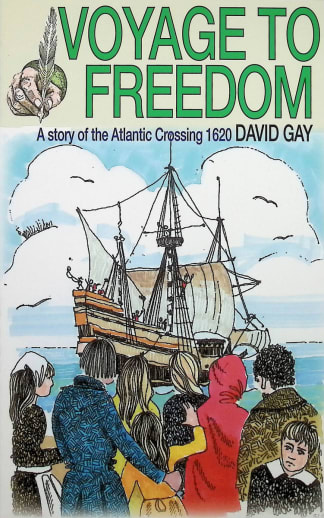
Join with a fictitious family as they embark on one of the most important and most well known voyages in United States history. Be there as they encounter hardship, danger, and excitement. Meet those people who were actually onboard when the ship made its crossing back in 1620 - Master Reynolds, John Howland, and William Butten. Witness also the incredible grace and blessing that the God bestowed on this boat load of Pilgrims. You guessed it, this is the true tale of the Mayflower's voyage, told as a story through the eyes of the Lovelace family. An enjoyable read for all ages. ~ Zach
Voyage to Freedom
SKU
015278
ISBN
9780851513843
Grade PK-AD
These icons are designed to help you quickly understand and learn important information about our products.
Teaching Method
Traditional
Teacher-centered curriculum commonly used in classrooms that may include a text, teacher manual, tests, etc.
Charlotte Mason
A methodology based on the work of a 19th century educator who maintained that children learn best from literature (Living Books), not textbooks.
Classical
A methodology based on the Latin Trivium (three stages of learning), including the grammar stage (memorization and facts), logic stage (critical thinking), and rhetoric stage (developing/defending ideas).
Unit Study
A thematic or topical approach centered around one topic that integrates multiple subject areas.
Montessori (Discovery)
A methodology based on the work of a 20th century educator that emphasizes student and sensory-driven discovery learning and real-life applications.
Other
Other methodologies
Religious Content
Secular
Contains content contrary to common Christian beliefs (i.e. evolution).
Neutral
Avoids religious or theoretical topics or presents multiple viewpoints without preference.
Christian/Religious
Faith-based or including instructional religious content.
Learning Modality
Auditory
Learns through listening, talking out loud or reading out loud.
Visual
Learns through seeing, prefers written instructions and visual materials.
Kinesthetic/Tactile (Hands-On)
Learns through moving, doing and touching.
Multi-Sensory
Curriculum that employ a variety of activities/components.
Presentation
Sequential
Curriculum progresses through well-defined learning objectives. Emphasizes mastery before moving to the next topic.
Spiral
Topics and concepts are repeated from level to level, adding more depth at each pass and connecting with review.
Conceptual/Topical
Focus is on the “why,” often with a unifying concept as well as specific skills; coverage may be broader.
Teacher Involvement
Low Teacher Involvement
Student-led materials; parent acts as a facilitator.
Medium Teacher Involvement
A mix of teacher-led time and independent student work.
High Teacher Involvement
Teacher-led lessons; may utilize discussions, hands-on activities and working together.
Additional Materials Required
No other materials needed
Everything you need is included.
Other Materials Required
There are additional required resources that are a separate purchase.
Other Materials Optional
There are additional resources mentioned or recommended but are not absolutely necessary.
Consumable
Consumable
Designed to be written in; not reusable.
Non-Consumable
Not designed to be written in; reusable.
Our Price
$12.00 $12.00 $10.95
Rainbow Savings: $1.05
Description
Publisher's Description of Voyage to Freedom
You are standing on a narrow quay-side waiting to board a small sailing ship. You are about to make an exciting but dangerous and uncomfortable voyage…’
So begins the lively and imaginative account of the voyage of the Mayflower which David Gay exciting historical narrative follows the nine week passage for the Pilgrims though the eyes of an imaginary family, Matthew and Martha Lovelace, with their typical children, Justice and Prudence. They encounter such fascinating characters as Master Reynolds, John Howland and William Butten- all of whom really took the Mayflower’s historic voyage. Here are three thousand miles of adventure, written with a sensitive appreciation of God’s care for his people, and of young people’s love for adventure.
Category Description for Veritas Press Elementary History (Grades 2-6)
Veritas Elementary History offers five different time periods, with each aimed at a different grade level beginning in grade 2 and designed to take one school year. There are a few components to this series that are offered in a kit or sold separately. The Teacher Manual is split into 32 weekly lessons. Each lesson has a worksheet, a project or two, and a test. The color-coded History Cards are an essential element of the program and contain many interesting facts from the various time periods. If the cards also relate to Bible history, they have another color and another number. Songs on the Audio CD are nicely done and designed as a type of auditory timeline.
Details
| Product Format: | Softcover Book |
|---|---|
| Grades: | PK-AD |
| Brand: | Banner of Truth |
| Author: | David Gay |
| ISBN: | 9780851513843 |
| Length in Inches: | 8.25 |
| Width in Inches: | 5.5 |
| Height in Inches: | 0.5 |
| Weight in Pounds: | 0.5 |
Videos
Reviews