
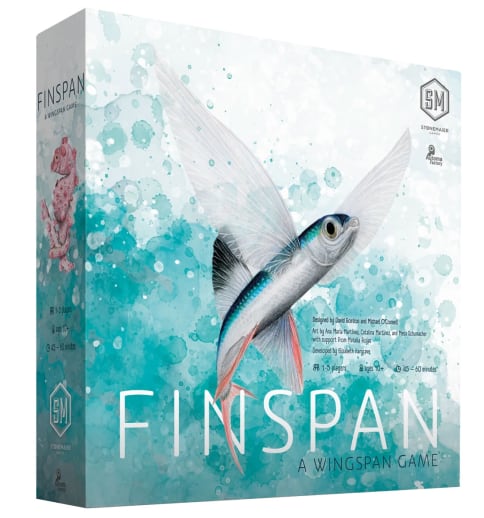
In Finspan, 125 fish are waiting for you in the sunlight, twilight, and
midnight depths of the ocean. Some of
these fish are predators and others, like the Black Hagfish, which can live in
all three of the ocean depths, produce copious amounts of expanding slime that
can fill even the largest predator’s mouth and gills. Besides being a beautifully produced
strategic adventure, Finspan provides interesting facts about each fish you
encounter during your play experience. Let’s dive into a few highlights of the
game with an overview of its components and how it plays!
There are four “weeks”, or rounds, in Finspan, consisting of
six turns per player. Players use one of their workers each turn to either play
a fish (card) or dive into the ocean to gather rewards and trigger activations
of played cards. Each player who joins this fintastic adventure starts with an
ocean board, which is the framework for all the actions they take during the
game. There are three fish printed on it to give them a starting point for
activation powers during their dives, as well as locations for laying
eggs. The goals during the game are to
play fish in the ocean by populating it with fish cards, laying eggs, hatching
them into hatchlings, and then forming schools of three hatchlings each. These
actions can all earn benefits and points during the game, at round end, and at
the end of the game.
What benefits can the fish cards earn? Each card shows a benefit that is either available immediately when a card is played, when activated during a dive, or at the end of the game. All benefits are optional and some are available to all players. Three examples of benefits are: 1) Put a hatchling on any fish card or open slot in your ocean; 2) hatch one egg so that it becomes a hatchling; 3) draw a fish card from the deck.
How do players earn points? There are four round-end point opportunities and five game-end point categories for scoring. At the end of each round, points are tallied on the score pad for each player’s achievements. Some examples are as follows: Gain two points for every three eggs in your ocean; gain two points for each large fish in your ocean. After all four rounds are complete, end-game points are scored as follows:
- Fish cards have game-end point opportunities based on specific conditions. An example is “Five points if this fish is in the bottom row of the ocean.”
- Consumed fish: During the game, if this benefit action is triggered, smaller fish can be “consumed” by placing larger fish on top of them. You earn points for each of these consumed fish.
- Each played fish card has a point value. Add up all visible fish card points in your ocean. Consumed fish card points are not included.
- One point for each egg and one point for each young “hatchling” on your board.
- 6 points for each school of fish in your ocean.
With this ocean adventure completed, the player with the
most points wins! When you want to play again, the Mediterranean
Damselfish, the Spookfish, the Atlantic Sailfish, and many more will be ready
for your return!
Published early in 2025, this game is a sequel to the “span”
series published by Stonemaier Games, beginning with Wingspan in 2019 and
followed by Wyrmspan in 2024. Although
these games are different enough to stand on their own, there are similar
mechanics in each of them. I like the
unified feel that comes through all three of these games with the use of cards,
eggs and resources, round-end goals, and card activations. Because of this,
once you have mastered one of these games, the other two will be easier to
learn.
Finspan accommodates up to five players and there is a solo specific mode with separate rulebook included. ~Marsha