These icons are designed to help you quickly understand and learn important information about our products.
Teaching Method
Traditional
Teacher-centered curriculum commonly used in classrooms that may include a text, teacher manual, tests, etc.
Charlotte Mason
A methodology based on the work of a 19th century educator who maintained that children learn best from literature (Living Books), not textbooks.
Classical
A methodology based on the Latin Trivium (three stages of learning), including the grammar stage (memorization and facts), logic stage (critical thinking), and rhetoric stage (developing/defending ideas).
Unit Study
A thematic or topical approach centered around one topic that integrates multiple subject areas.
Montessori (Discovery)
A methodology based on the work of a 20th century educator that emphasizes student and sensory-driven discovery learning and real-life applications.
Other
Other methodologies
Religious Content
Secular
Contains content contrary to common Christian beliefs (i.e. evolution).
Neutral
Avoids religious or theoretical topics or presents multiple viewpoints without preference.
Christian/Religious
Faith-based or including instructional religious content.
Learning Modality
Auditory
Learns through listening, talking out loud or reading out loud.
Visual
Learns through seeing, prefers written instructions and visual materials.
Kinesthetic/Tactile (Hands-On)
Learns through moving, doing and touching.
Multi-Sensory
Curriculum that employ a variety of activities/components.
Presentation
Sequential
Curriculum progresses through well-defined learning objectives. Emphasizes mastery before moving to the next topic.
Spiral
Topics and concepts are repeated from level to level, adding more depth at each pass and connecting with review.
Conceptual/Topical
Focus is on the “why,” often with a unifying concept as well as specific skills; coverage may be broader.
Teacher Involvement
Low Teacher Involvement
Student-led materials; parent acts as a facilitator.
Medium Teacher Involvement
A mix of teacher-led time and independent student work.
High Teacher Involvement
Teacher-led lessons; may utilize discussions, hands-on activities and working together.
Additional Materials Required
No other materials needed
Everything you need is included.
Other Materials Required
There are additional required resources that are a separate purchase.
Other Materials Optional
There are additional resources mentioned or recommended but are not absolutely necessary.
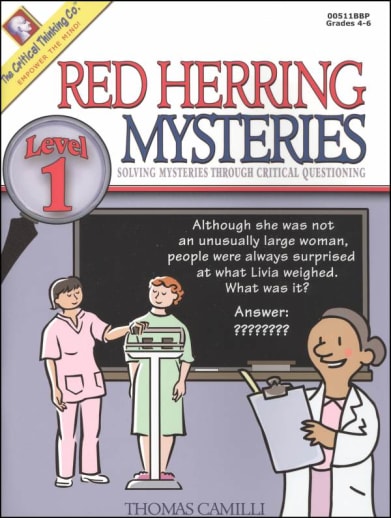
Publisher's Description of Red Herring Mysteries, Level 1
Students LOVE these entertaining
mysteries that develop students' inferential and deductive thinking skills for
more effective reading, listening, and logical thinking. The activities also
sharpen analyses, synthesis, and investigative skills as well as encourage
creative brainstorming and flexible thinking.
Each of the "mysteries" is part of a longer untold story which is
"behind the scenes." It is up to the students to deduce the rest of
the story from clues derived from answers to their Yes/No questions. For
example, the story behind the sentence, "If Leo had kept his hand down he
might be a free man today," can eventually be revealed if enough questions
are asked and the answers are used to form a mental image of the event. It may
take many Yes/No questions over several days to finally reveal that Leo is a not
too-bright bank robber who incriminates himself at his trial by raising his
hand when the prosecutor asks a witness, "Is the person who robbed the
bank present in the courtroom today?"
Red Herring Level 1 includes: solution tips, suggestions, answers,
a sample questioning session, and thinking map (organizer) to keep track of
student thinking.
Get your children thinking "out of the box" with these books of sparker situations from the Critical Thinking Company. A seemingly strange or incongruous scenario is set in a brief story. Students must then make inferences, use deduction, develop lines of reasoning, think creatively, and look beyond the obvious to figure out a solution or reason that makes sense. Students ask teachers/parents yes or no questions about the story to try and figure out exactly what happened. The books progress in difficulty (both between and within books) and are self-contained with usage tips, reproducible graphic organizers, stories, and solutions all in one neat little book. Students keep track of their clues until they are finally able to come up with the correct solution. This series provides a great way to show students how to solve mysteries or problems through critical questioning. Previously published as Case of Red Herrings, Books about 70 pgs, pb.