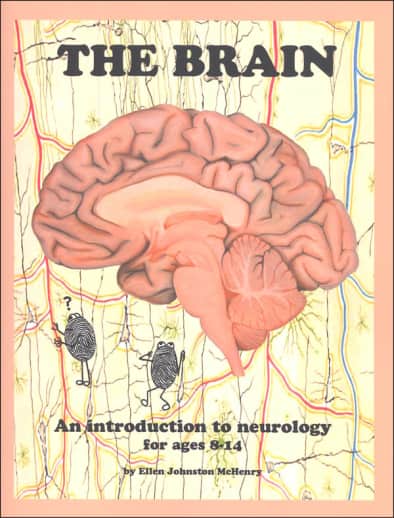

New 2nd edition (2022) updates include: book is now bound (not looseleaf and not 3-hole punched), some color images have been added, and video links have been updated.
While I already knew that Ellen McHenry has a talent for making complicated topics fun and understandable for middle schoolers, I was impressed all over again when I saw this study on the brain. I mean, it seems manageable to teach chemistry to kids, but neurology? Things can get complicated when you start following nerve pathways across and through the brain! However, I was relieved to see that you don't need to be a brain surgeon to teach this course.
The book has two parts: the student content and an answer key, both of which include reproducibles that you can copy for your own family or one classroom. The student content is at the core of the course and includes all of the text and text-based activities. There are ten topical chapters in the booklet, plus "half-chapters" that end in .5 and cover "extras" that you could choose to cover or skip, depending on your interest and time available. The chapters cover the history of brain research, basic brain anatomy, the right and left sides of the brain, the parts of the brain and their functions, brain cells, neurons, learning and memory, the brain's connection to the body, sleep and brain doctors. Each chapter includes several pages of friendly, straight-forward text on the topic, augmented by graphics and the little fingerprint guys you might recognize from the author's chemistry programs. Several review activities are provided at the end of each chapter. These are quite wide-ranging in format, so much so that I'm just going to have to give you specific examples! For instance, in the first chapter on brain research, the first activity asks students to research different brain scans on the internet and answer a question about each, then read to find out more about Phineas Gage (the strangest story in brain research!). Finally, students complete a color-by-number "PET Scan." In the chapter about brain parts and functions you'll find a crossword puzzle to complete, a diagram to color the parts of the brain, and "The Brain Song" to listen to, which is available as a download on the author's website.
Other fun activities include making a 9-square puzzle of connected neurons and using the right and left sides of your brain to complete specific challenges. An answer key is provided at the end of the student portion and contains all of the answers to activities with specific answers. The teacher's section is primarily made up of more involved, hands-on activities. These are organized by corresponding chapter and include fun ideas like making a brain "hemisphere hat" using the reproducible patterns that show the different areas of the brain, doing an MRI on an orange, making a human neuronal network, building an edible neuron, and much, much more. I was very impressed with the hands-on activities overall; they are very creative! This would be a very fun curriculum to use with a co-op, or with several of your children at one time. I would recommend finding some good text resources on the brain, as the visuals are a bit limited here and there may be topics you'll want to read more about. I do, however, think the content and the activities here will definitely capture children's interest! 140 pages. ~ Jess/Sara